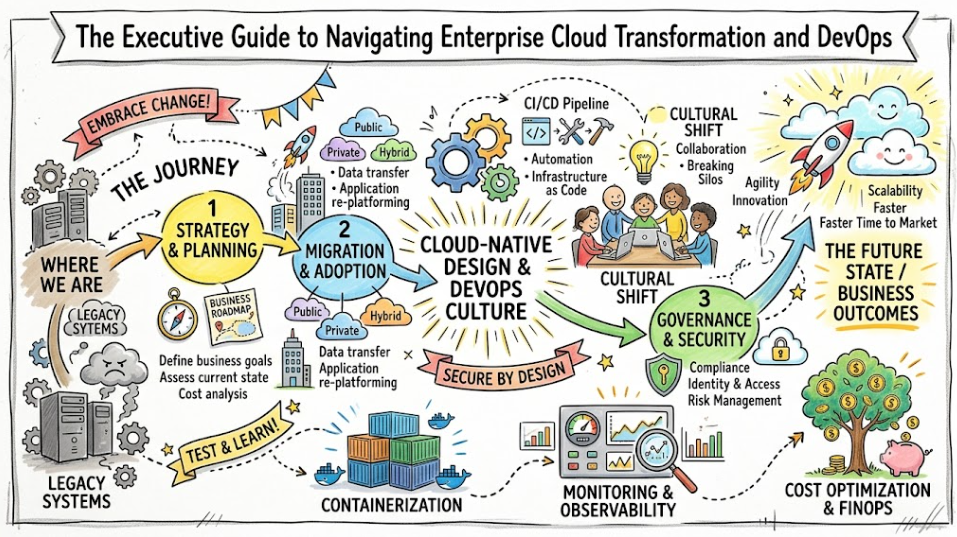
Introduction
Modern business landscapes require organizations to adapt at a pace never seen before. Customer expectations shift in days rather than years, forcing traditional industries to reconsider how they deliver value. Companies that used to rely on annual software update cycles now find themselves lagging behind competitors who deploy software updates multiple times a day.
Traditional IT operations often struggle to meet these new market pressures. For decades, software development and infrastructure operations existed as isolated entities. Developers were incentivized to write code quickly and introduce new features, while operations teams were tasked with maintaining environment stability, which often meant resisting frequent changes. This structural division created significant delays, misaligned priorities, and unstable software rollouts.
As a result, the demand for faster, predictable innovation has become a core business survival metric. Organizations can no longer treat software development as a secondary support function. Software has become the primary mechanism through which businesses engage with customers, optimize internal supply chains, and secure market share.
This systemic bottleneck is why DevOps supports digital transformation fundamentally. DevOps bridges the historical gap between software creation and production deployment. By integrating these practices, organizations can transition from rigid, legacy operational paradigms into highly adaptive digital enterprises. To understand this structural shift deeper, professionals often look to platforms like DevOpsSchool to build the core competencies required to execute these complex organizational transitions.
Consider a retail banking institution attempting to launch a mobile check-deposit feature. Under traditional IT models, setting up infrastructure, testing code branches manually, and passing security audits could take up to six months. By the time the feature launched, market dynamics might have changed completely. Implementing a unified development and operations model compresses this timeline into days, turning technology from an operational bottleneck into a distinct competitive advantage.
What Is Digital Transformation?
Digital transformation represents the strategic integration of digital technology across all areas of a business, fundamentally changing how the organization operates and delivers value to its customers. It is not merely about replacing paper processes with digital spreadsheets or hosting legacy code on a remote server. Instead, it requires a complete cultural and structural shift that challenges the status quo and forces organizations to experiment continuously.
At its core, this transformation changes how a business responds to market signals. It alters the underlying operational models, engineering workflows, and customer communication channels. The primary objective is to build an adaptable enterprise that can survive and thrive during periods of intense technological disruption.
Business Example: Think of a traditional logistics and shipping firm. Originally, the business relied on manual logs, phone calls, and physical paperwork to track assets across territories. Digital transformation involves deploying IoT sensors on cargo fleets, building predictive analytics platforms to optimize delivery routes, and creating a real-time tracking interface for global clients. Technology becomes the operational foundation of the company.
Why Traditional IT Models Struggle
Traditional IT frameworks were engineered for an era where predictability and risk minimization were prioritized over delivery speed. These models relied heavily on sequential, phase-driven methodologies where work moved slowly through highly isolated departments. While this structure provided a clear chain of command, it created major operational challenges for modern digital businesses.
Slow and Fragmented Delivery Cycles
In legacy frameworks, projects move linearly through requirements gathering, architecture, coding, testing, and deployment phases. If an architectural flaw is discovered during the late manual testing phase, the entire project must be sent back to the beginning of the cycle. This creates multi-month delays, meaning software is often outdated by the time it reaches actual users.
Siloed Engineering Teams
Traditional organizations separate developers, quality assurance teams, database administrators, and systems operators into distinct operational silos. Each team has its own tools, metrics, and internal management structures. This isolation fosters a culture of blame, where teams focus on fulfilling their narrow departmental goals rather than optimizing the broader software delivery pipeline.
[Development Team] ──(Throws Code Over The Wall)──> [Operations Team]
  (Focus: Fast Features)                             (Focus: System Stability)
Legacy Infrastructure and Manual Management
Older systems rely heavily on manual configuration management. Systems engineers must log directly into bare-metal servers or isolated virtual machines to install security patches, update runtime environments, and configure networking paths. This hands-on approach introduces human errors, configuration drift between environments, and makes horizontal scaling incredibly slow.
What Role DevOps Plays in Digital Transformation
DevOps serves as the operational engine that translates digital transformation strategies into tangible business capabilities. It eliminates the friction between software creation and deployment by unifying personnel, refining development processes, and implementing modern automation tools.
| DevOps Area | Business Impact |
| Faster Software Delivery | Reduces time-to-market for digital products, helping businesses respond quickly to market changes. |
| Automation | Eliminates manual errors, cuts operational overhead, and ensures predictable deployments. |
| Cloud Enablement | Unlocks infrastructure flexibility, allowing applications to scale dynamically based on customer demand. |
| Better Collaboration | Aligns engineering and operations teams around shared business goals and performance metrics. |
| Continuous Improvement | Introduces short feedback loops to refine software features based on real-world usage data. |
| Monitoring and Reliability | Provides real-time visibility into system health, reducing downtime and protecting revenue. |
| Customer-Focused Innovation | Shifts engineering focus toward delivering stable, high-value features directly to users. |
Area #1: Faster Software Delivery
Digital transformation requires organizations to deliver new software features and security fixes to market with minimal delay. DevOps facilitates this through Continuous Integration and Continuous Deployment pipelines. Instead of bundling hundreds of software changes into a risky quarterly release, developers merge small code updates into a shared repository multiple times a day.
Every code change triggers automated build and test sequences immediately. This ensures that software defects are identified and resolved within minutes of being written, rather than weeks later during a manual testing phase. This continuous flow drastically reduces production deployment risks.
[Developer Code Commit] ──> [Automated Build] ──> [Automated Test] ──> [Production Deployment]
Real-World Business Scenario
An insurance provider needs to update its claims processing algorithm to comply with new regional regulations. Using a traditional deployment model, updating this algorithm requires taking the entire application offline during a weekend maintenance window, causing service disruptions.
With an automated delivery pipeline, the engineering team safely tests the updated algorithm in a simulated production environment. Once validated, the pipeline deploys the change progressively to users without any application downtime. The business ensures compliance immediately while maintaining uninterrupted customer service.
Area #2: Automation
Manual software configurations are slow, error-prone, and difficult to audit. DevOps addresses this vulnerability by prioritizing comprehensive automation across the entire lifecycle, ranging from environment setup to testing and patch management.
By treating infrastructure configuration exactly like application software—a practice known as Infrastructure as Code—organizations can define networks, servers, storage components, and security policies using version-controlled text files. This eliminates the need for manual server setup and ensures consistency across all deployment environments.
Practical Automation Workflow
- Code Validation: Linters and static analysis tools review code formatting and identify security vulnerabilities immediately upon developer check-in.
- Environment Provisioning: Automated scripts provision identical, isolated infrastructure environments for development, testing, and production stages.
- Integration Testing: Automated test suites execute functional, performance, and security tests against the newly provisioned environments.
- Artifact Management: Successful builds are compiled into immutable deployment packages and stored in secure registries.
- Progressive Rollout: Orchestration engines deploy the verified artifacts to production servers using blue-green or canary release strategies to minimize user impact.
Area #3: Cloud Enablement
Digital transformation initiatives regularly stall when bound to rigid, on-premises data centers. DevOps methodologies unlock the true potential of cloud computing by designing applications and infrastructure pipelines optimized for cloud environments.
This synergy allows systems to scale resources up or down automatically based on real-time application traffic. It shifts technology spending from restrictive, upfront capital expenditures to flexible operational expenses, allowing businesses to experiment with new digital initiatives without expensive hardware commitments.
Realistic Architecture Example
An media streaming service experiences massive traffic surges in the evening hours, while daytime usage remains low. In a legacy data center model, the company must purchase and maintain enough physical servers to handle peak evening traffic, leaving expensive hardware idle during the day.
Peak Hours (Evening): [Scale Up Servers]  ───> Handles high user volume smoothly
Off-Peak Hours (Day): [Scale Down Servers] ───> Reduces cloud infrastructure costs
By leveraging cloud native architectures managed through automated infrastructure pipelines, the streaming service scales its compute instances up during peak hours to ensure smooth playback. When demand drops, the system scales down automatically, minimizing cloud infrastructure costs.
Area #4: Better Collaboration
A successful digital transformation requires breaking down long-standing corporate silos. DevOps transforms organizational culture by aligning software developers, systems operators, security professionals, and business stakeholders around shared operational goals.
Instead of operating in isolation, these teams share common metrics, such as deployment frequency, change failure rates, and mean time to recovery. This shared ownership removes the friction common in traditional IT models, fostering an environment where teams work together to solve business challenges.
Workplace Scenario
A production application experiences a sudden database connection failure. In a traditional IT environment, the operations team blames the developers for writing inefficient database queries, while the developers blame the operations team for misconfiguring the database server.
In a mature DevOps model, engineers from both disciplines gather in a shared communication channel. They review centralized log dashboards together, identify a network configuration error, apply an automated patch, and conduct a blameless post-mortem review to ensure the issue does not occur again.
Area #5: Continuous Improvement
Digital transformation is not a static project with a fixed endpoint; it is a continuous journey of operational refinement. DevOps supports this by embedding feedback loops into every phase of the software delivery pipeline.
By analyzing data from software testing, production performance, and user interactions, engineering teams can make precise, incremental improvements to their applications. This ensures that software continuously evolves to meet user needs and operational standards.
┌─────────────────────────────────────────┐
│                                         ▼
[Plan] ──> [Build] ──> [Deploy] ──> [Monitor & Analyze Data]
Practical Business Example
An online education platform notices a drop-off in user engagement on its course registration page. Rather than guessing at a solution, the product team deploys two small variations of the interface simultaneously to different user segments.
By analyzing the automated telemetry and conversion metrics of both groups over a week, the team identifies the design that performs better. They permanently deploy the successful interface, leveraging data-driven feedback to improve business results.
Area #6: Monitoring and Reliability
As systems grow more complex during digital transformation, maintaining application uptime becomes critical. DevOps ensures system reliability by replacing reactive troubleshooting with proactive, real-time monitoring and alerting platforms.
Continuous observability tools collect metrics, logs, and distributed traces from every layer of the infrastructure and application stack. This deep visibility allows engineering teams to detect anomalies and resolve performance degradation before actual users even notice an issue.
Realistic Incident Response Workflow
- Anomaly Detection: Automated monitoring systems detect a sudden spikes in response latency on an e-commerce checkout service.
- Automated Alerting: The platform sends a detailed alert containing contextual log data to the on-call Site Reliability Engineering team.
- Dynamic Auto-Healing: While engineers investigate, an automated orchestration script provisions additional service instances to handle the load and stabilize latency.
- Root Cause Analysis: Engineers use centralized tracing dashboards to isolate a slow third-party payment gateway API as the root cause.
- Circuit Breaking: The team activates a circuit-breaker pattern, temporarily routing transactions through an alternative payment processor to maintain checkout functionality.
Area #7: Customer-Focused Innovation
The ultimate goal of digital transformation is to deliver better experiences to customers. DevOps enables customer-focused innovation by removing the technical boundaries that prevent product teams from experimenting safely with new features.
When deploying software changes carries low risk, organizations can release innovative capabilities frequently. This allows businesses to test new concepts in production with actual users, gather feedback early, and adjust their product roadmaps based on real-world market validation.
Enterprise Examples
- FinTech Platforms: Introducing localized payment options within hours to capitalize on regional shopping trends.
- SaaS Providers: Offering personalized feature flags that allow specific enterprise clients to test beta tools safely before a global launch.
- Healthcare Portals: Updating telehealth interfaces quickly based on accessibility feedback from elderly patients.
Real-World Example: Company Without DevOps
To understand the practical impact of DevOps on digital transformation, consider the operational struggles of an enterprise retail brand operating with legacy IT methodologies during a major seasonal sales event.
[Developer Fixes Code] ──> [Manual QA Backlog] ──> [Manual Server Setup] ──> [Deployment Failure]
The Scenario
The company plans to launch a promotional discount campaign across its digital storefront. Developers spend weeks writing the code for the promotional engine on their local laptops.
The Operational Breakdown
- Deployment Delays: The code is handed off to a separate quality assurance team, which spends days running manual tests, creating a massive backlog.
- Environment Configuration Mismatches: When approved, the operations team attempts to deploy the code to production servers manually. However, because production servers use a different operating system patch version than the developers’ laptops, the code fails to run properly.
- System Outages: The storefront website crashes under the sudden surge of promotional traffic. The operations team lacks centralized logging tools, spending hours manually inspecting server logs to diagnose the issue.
- Business Impact: The promotional campaign fails, customers abandon their shopping carts in frustration, and the company suffers significant revenue loss along with long-term brand damage.
Real-World Example: Company Using DevOps for Transformation
Now let us examine the exact same seasonal sales scenario executed by a competitor retailer that has successfully integrated DevOps into its digital transformation strategy.
The Scenario
The development team builds the promotional engine within an integrated ecosystem. Every code modification is automatically packaged into a standardized container artifact that behaves identically across all testing and production systems.
[Code Artifact Built] ──> [Automated Test Suite] ──> [Canary Rollout] ──> [Auto-Scale Traffic]
The Operational Success
- Automated Validation: The automated delivery pipeline validates the code through rigorous integration and load testing suites within minutes of a code commit.
- Canary Deployments: The release orchestration system rolls out the promotional update progressively, initially sending it to just 5% of web traffic to ensure stability.
- Elastic Resource Scaling: As promotional traffic surges, cloud monitoring systems trigger auto-scaling policies, automatically adding web server instances to distribute the load evenly.
- Proactive Resolution: Telemetry dashboards identify a minor memory leak in a microservice. The automated platform isolates the affected container instance and restarts it without disrupting active shoppers.
- Business Impact: The promotional campaign runs smoothly, handling record traffic without downtime, driving significant revenue growth and building customer loyalty.
Benefits of DevOps in Digital Transformation
Integrating DevOps into a digital transformation strategy yields measurable benefits across an entire enterprise. It optimizes technology operations and directly impacts business performance metrics.
Enhanced Business Agility
Organizations can pivot their technology strategies rapidly in response to market disruptions or competitive threats. New product concepts transition from ideation to production in days, allowing the business to capture emerging market opportunities ahead of competitors.
Improved Operational Reliability
Automated testing frameworks and proactive monitoring drastically reduce production failures. When issues do occur, continuous deployment pipelines allow teams to deploy hotfixes or roll back changes immediately, minimizing system downtime.
Optimizing Technology Expenditures
Infrastructure automation and cloud-native scaling patterns eliminate the waste associated with over-provisioned hardware. Organizations pay only for the exact computing capacity they use, maximizing their return on technology investments.
Cultivating Modern Innovation
By automating repetitive engineering tasks like manual testing and infrastructure setup, developers can focus on their core job: writing high-value code that solves customer problems and drives business growth.
Challenges of DevOps Adoption
While the benefits are clear, transitioning to a DevOps operational model involves navigating significant organizational challenges. It is a complex transformation that extends far beyond upgrading software tools.
Cultural Resistance to Change
The biggest hurdle in a DevOps transformation is cultural resistance. Teams are often comfortable with their historical ways of working. Operations engineers may fear losing operational control, while developers might resist taking on post-deployment operational responsibilities.
Pervasive Technical Skill Gaps
Modern cloud-native and automated workflows require specialized skills. Many legacy IT professionals lack hands-on experience with containerization, infrastructure orchestration, cloud architecture, and automated pipeline configuration, creating implementation bottlenecks.
Managing Complex Toolchains
The modern DevOps ecosystem includes hundreds of specialized tools for version control, continuous integration, configuration management, and monitoring. Selecting, integrating, and maintaining a cohesive toolchain across an enterprise presents a major engineering challenge.
Common Mistakes Organizations Make
Many enterprises stumble during their transformation journeys because they misunderstand the fundamental principles of DevOps. Avoiding these common mistakes can save organizations years of frustration and wasted capital.
Transformation Pitfalls Checklist
- [ ] Adopting a Tool-First Mindset: Buying expensive licenses for automation software while leaving broken, siloed team workflows unchanged.
- [ ] Neglecting Organizational Culture: Focusing entirely on technical architectures while failing to address team communication problems and misaligned performance incentives.
- [ ] Attempting Full Transformation at Once: Trying to transition every legacy enterprise application to DevOps overnight, creating massive confusion and operational instability.
- [ ] Setting Unrealistic Expectations: Expecting immediate improvements in delivery velocity without allocating proper time for engineering teams to learn new skills and pay down technical debt.
- [ ] Excluding Security Teams: Treating security compliance as an afterthought at the end of the deployment cycle rather than integrating it directly into the automated pipeline.
Best Practices for Successful DevOps Transformation
A successful DevOps-driven digital transformation requires a structured, iterative approach that prioritizes cultural alignment along with technical modernization.
Implementation Action Plan
- [ ] Start with Small, Meaningful Projects: Select a non-critical but highly visible application to serve as a pilot project. Use this project to refine workflows, test tools, and demonstrate clear success to the rest of the organization.
- [ ] Automate Core Processes Gradually: Focus on automating the most painful operational bottlenecks first, such as manual build steps or slow testing processes, before attempting full pipeline automation.
- [ ] Invest in Continuous Team Training: Provide clear learning paths for engineering and operations personnel to build expertise in cloud platforms, infrastructure management, and automated architectures.
- [ ] Establish Shared Engineering Metrics: Align developers and operations engineers around common performance goals, such as deployment frequency, lead time for changes, and mean time to recovery.
- [ ] Encourage Open, Blameless Feedback: Turn operational incidents into learning opportunities. Conduct open reviews focused on fixing system flaws rather than pointing fingers at individual engineers.
Role of DevOpsSchool in Learning DevOps Transformation
Navigating the complexities of an enterprise-wide technology transformation requires deep expertise and structured education. Organizations and individual professionals often turn to structured educational platforms to successfully bridge these modern knowledge gaps.
Platforms like DevOpsSchool play an important role in this journey by providing practical, comprehensive training programs designed for real-world scenarios. Instead of focusing entirely on theoretical concepts, these programs emphasize hands-on exposure to the entire modern engineering ecosystem.
Professionals gain a deep understanding of building automated delivery pipelines, managing infrastructure through code, and designing highly resilient cloud architectures. This practical training helps engineering teams build a cloud-native mindset, allowing them to shift away from old manual deployment habits.
By educating professionals on how to connect various tools into a reliable workflow, such learning ecosystems help organizations build the skills needed to lead successful digital transformations inside their enterprises.
Career Importance of DevOps in Digital Businesses
As enterprises across the globe prioritize digital transformation, the demand for skilled professionals who understand both software development and systems operations has grown rapidly. This shift has made DevOps expertise highly valuable in the modern job market.
Key Professional Roles
DevOps Engineer
Engineers who design, build, and maintain automated software delivery pipelines. They bridge the gap between development and operations teams, ensuring smooth, secure code deployments.
Cloud Architect
Specialists who design scalable, secure, and cost-effective infrastructure environments within public, private, or hybrid cloud platforms to support modern applications.
Platform Engineer
Engineers focused on building internal developer platforms and self-service tools that allow product teams to deliver code quickly and independently.
Site Reliability Engineer (SRE)
Practitioners who apply software engineering principles directly to infrastructure operations challenges, focusing on maximizing application uptime, reliability, and performance.
DevOps Consultant
Senior advisors who guide enterprises through the cultural, structural, and technical changes required to adopt automated operational models successfully.
Enterprise Skill Expectations
Modern businesses look for professionals who possess a balance of technical and soft skills. This includes proficiency in scripting and automation languages, hands-on experience with cloud infrastructure, an understanding of automated security practices, and strong communication skills to collaborate effectively across diverse business units.
Industries Driving Digital Transformation With DevOps
DevOps adoption is no longer limited to silicon valley technology firms. Traditional industries around the world are leveraging these practices to modernize their operations and protect their market positions.
Banking and Financial Services
FinTech platforms and traditional banks use automated pipelines to deliver secure, regulatory-compliant software updates to mobile banking apps. This allows them to introduce features like instant fraud detection and personalized lending algorithms ahead of the competition.
Healthcare and Life Sciences
Medical systems adopt cloud-native frameworks to securely manage large volumes of patient data. Automated deployments allow telehealth portals to update features quickly while maintaining strict patient data privacy standards.
E-Commerce and Retail
Global retail brands use elastic cloud auto-scaling and containerized architectures to manage unpredictable traffic spikes during major holiday shopping events, ensuring uninterrupted checkout experiences for users.
Telecommunications
Telecom operators utilize infrastructure automation to manage complex network environments and deploy 5G network components quickly, reducing operational costs and improving service reliability.
Software-as-a-Service (SaaS) Platforms
Modern cloud software providers rely completely on continuous integration and deployment pipelines to ship bug fixes and feature updates to millions of global users simultaneously without service interruptions.
Future of DevOps in Digital Transformation
The intersection of DevOps and digital transformation continues to evolve as new technologies emerge. Organizations must monitor these trends to ensure their engineering strategies remain competitive.
AI-Assisted Operations (AIOps)
Artificial intelligence and machine learning models are being integrated directly into monitoring and observability platforms. These tools analyze massive amounts of system telemetry data to predict infrastructure failures, optimize resource utilization, and automate incident resolution before service degradation occurs.
Platform Engineering and Developer Self-Service
To reduce cognitive load on developers, organizations are moving toward platform engineering. Centralized teams build internal developer platforms that provide automated, self-service access to infrastructure resources, allowing product teams to focus entirely on feature development.
Cloud-Native Ecosystems and Serverless Architectures
The adoption of microservices, container orchestration platforms like Kubernetes, and serverless computing models will continue to grow. These architectures allow applications to be highly modular, enabling independent scaling and rapid deployments.
Security-First Transformation (DevSecOps)
As cyber threats become more sophisticated, security can no longer be treated as a final check at the end of the delivery cycle. The future requires embedding automated security compliance checks directly into every stage of the development pipeline, ensuring software is secure by design.
FAQs
What is digital transformation?
Digital transformation is the strategic integration of digital technologies across all areas of a business. It fundamentally alters how an organization operates, manages internal workflows, and delivers value to its customers.
How does DevOps help transformation?
DevOps supports transformation by breaking down the traditional boundaries between software development and IT operations teams. It introduces automation, continuous delivery pipelines, and shared metrics to help businesses deliver stable software updates to the market faster.
Is DevOps only for large enterprises?
No. While large enterprises benefit significantly from DevOps when modernizing legacy systems, small businesses and startups use these practices to scale their software products efficiently and avoid building operational silos early on.
Can small businesses use DevOps effectively?
Yes. Small businesses can leverage cloud-native tools and automated platforms to build resilient deployment pipelines with minimal upfront investment, allowing them to compete effectively with larger organizations.
What tools support a DevOps transformation?
Common tools include git for version control, Jenkins or GitHub Actions for continuous integration, Docker and Kubernetes for containerization, Terraform for infrastructure management, and Prometheus or Grafana for system monitoring.
Why is automation important in DevOps?
Automation removes slow, error-prone manual steps from the software delivery lifecycle. It ensures that software builds, testing sequences, and infrastructure deployments are executed consistently and predictably every time.
Does DevOps improve the final customer experience?
Yes. By speeding up software delivery and reducing production errors, DevOps allows businesses to respond to customer feedback quickly, deploy new features reliably, and resolve application bugs with minimal service disruption.
Can beginners learn DevOps?
Yes. Beginners can learn DevOps by building a foundational understanding of Linux administration, basic scripting languages, version control systems, and fundamental networking concepts before moving on to advanced automation tools.
What is the difference between DevOps and Agile?
Agile is a software development methodology focused on iterative project management and team collaboration to write code. DevOps extends these principles to include IT operations, ensuring that code updates are deployed to production safely and efficiently.
How long does a DevOps transformation take?
A comprehensive DevOps transformation is a long-term cultural and structural shift rather than a quick software upgrade. While initial technical improvements can be achieved in months, building a mature DevOps culture across an enterprise typically takes a few years of continuous refinement.
What is a CI/CD pipeline?
Continuous Integration and Continuous Deployment (CI/CD) is an automated framework that compiles, tests, and deploys code modifications to production environments automatically whenever a developer submits updates to a shared repository.
What role does cloud computing play in DevOps?
Cloud computing provides the flexible, programmable infrastructure that DevOps automation requires. It allows infrastructure pipelines to dynamically scale compute and storage resources based on real-time application demands.
How do you measure the success of a DevOps transformation?
Success is measured using core industry metrics, including deployment frequency, lead time for changes, change failure rates, and mean time to recovery when an operational incident occurs.
Is DevOps primarily a technology change or a cultural change?
It is both, but culture is the foundation. While automation tools are necessary to run modern deployment pipelines, they cannot deliver real business value unless teams shift their culture toward shared ownership, open communication, and continuous learning.
What are the core skills needed for a DevOps career?
Key skills include proficiency in scripting languages like Python or Bash, experience with cloud platforms, knowledge of containerization tools, an understanding of automated testing frameworks, and strong collaborative communication habits.
Final Thoughts
Stepping back from the technical definitions, a senior mentor will tell you that a successful technology transformation is fundamentally about building business agility. DevOps is not a magical product you buy off the shelf or a collection of tool certifications you hang on a wall; it is a long-term commitment to operational excellence, open team collaboration, and continuous improvement.
Modernizing an enterprise takes time, and navigating this journey requires patience. Organizations must look past the initial industry hype and focus on the practical reality: shifting engineering culture matters just as much as deploying the latest automation tools.
True transformation happens incrementally, through small, deliberate improvements made to your delivery pipelines every single day. By prioritizing continuous learning, breaking down internal operational silos, and building reliability directly into your software architecture, your organization can successfully navigate the complexities of modern digital business landscapes.
