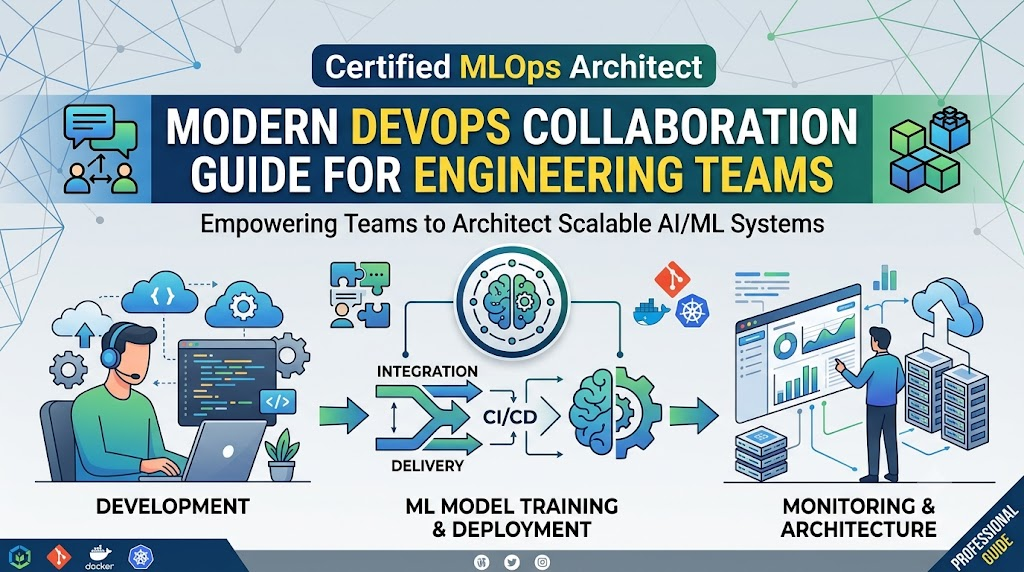
In the early days of software development, the process was linear and rigid. Developers wrote code, then tossed it over the wall to the Operations team to deploy. If something broke, the blame game began immediately. This fragmentation created massive delays, frustrated engineers, and unhappy customers. As software complexity grew, organizations realized that faster delivery required a fundamental shift in how teams interact.
This is where DevOps emerged not just as a set of tools, but as a culture. By bridging the gap between historically isolated groups, DevOps turned software delivery into a unified effort. To master these principles, many professionals turn to resources like DevOpsSchool to understand the core workflows that make this possible. Building successful software today is no longer about working in a vacuum; it is about seamless teamwork.
What Collaboration Means in DevOps
At its heart, collaboration in DevOps means breaking down the walls between those who build the software and those who maintain it. Instead of seeing these as separate phases, DevOps treats the entire lifecycle as a continuous process where every team member is involved from start to finish.
Think of it like a professional orchestra. The conductor does not play the instruments, but they ensure the violinists, percussionists, and horn players are all in sync. In a DevOps environment, team members from development, operations, and security are those musicians. If one section plays out of tune, the entire performance suffers. Collaboration is the sheet music—it provides the shared language and structure that allows everyone to perform at their best.
Why Traditional IT Teams Struggled With Collaboration
Traditional IT structures were built on functional silos. Developers were incentivized to create new features as quickly as possible, while Operations teams were incentivized to keep systems stable and minimize changes. These opposing goals created a natural friction.
When a deployment failed, the lack of shared context led to finger-pointing rather than problem-solving. Developers would say, It works on my machine, while Operations would say, Your code broke the environment. This constant tug-of-war hindered progress and kept organizations stuck in a cycle of manual fixes and slow releases.
Comparison of Traditional Team Dynamics
| Development Team | Operations Team |
| Goal: Feature velocity and innovation | Goal: System stability and uptime |
| Responsibility: Writing and testing code | Responsibility: Deploying and monitoring code |
| Frustration: Operations is too slow to deploy | Frustration: Code is poorly written or unstable |
Why DevOps Emphasizes Collaboration
DevOps shifts the focus from individual departmental wins to collective delivery outcomes. When collaboration becomes the priority, the “us versus them” mentality disappears. Instead, the focus shifts to how the entire system can deliver value to the user.
For example, when a developer participates in the deployment process, they gain empathy for the challenges the Operations team faces. When an Operations engineer provides feedback during the design phase, they can identify potential scaling bottlenecks early. This shared ownership drastically reduces the time spent on rework and debugging.
Role of Communication in DevOps Success
In a high-performing DevOps team, communication is constant and transparent. It is not just about having meetings; it is about using shared dashboards, automated alerts, and collaborative chat platforms to keep everyone informed.
If a production incident occurs, a collaborative team does not hunt for a scapegoat. Instead, they use communication channels to share data, troubleshoot in real-time, and implement a fix as a unified front. This shared understanding of the system health means that everyone knows exactly what to do when something goes wrong, leading to faster recovery times and higher reliability.
How DevOps Encourages Cross-Functional Teams
DevOps encourages bringing together diverse expertise into a single, cohesive unit. This typically involves:
- Developers: Creating the core application logic.
- Operations: Ensuring the infrastructure is robust, scalable, and secure.
- QA: Automating testing to ensure quality is baked into every commit.
- Security: Integrating compliance and protection directly into the development workflow (often called DevSecOps).
When these roles work side-by-side, they create a feedback loop. Developers get instant feedback on performance, and Operations gets the context they need to manage the infrastructure effectively.
Shared Responsibility in DevOps Culture
Shared responsibility is the bedrock of a healthy DevOps culture. It means that everyone on the team is accountable for the end result. If the software is slow, it is not just an Operations issue. If the release is buggy, it is not just a Developer issue.
By removing departmental walls, everyone is invested in the success of the release. This mindset shift encourages team members to help each other, share knowledge, and proactively solve problems before they escalate. When a team realizes that they win or lose together, they naturally start communicating more effectively.
Real-World Example: Team Without Collaboration
Imagine a team where the developers are strictly siloed from the operations team. The developers finish their project and hand over a bundle of code with minimal documentation. The operations team, struggling to understand the new dependencies, tries to deploy it manually.
The deployment crashes the production environment. The operations team spends hours trying to patch it, while the developers move on to their next task. The end result is a multi-hour outage, a tense post-mortem meeting filled with blame, and a complete breakdown of trust between the two groups.
Real-World Example: Team With Strong DevOps Collaboration
Contrast this with a team that practices strong collaboration. Before a single line of code is written, both developers and operations engineers meet to discuss the deployment requirements. They use automated pipelines to ensure that every change is tested in an environment that mimics production.
When a deployment occurs, automated monitoring sends alerts to both teams simultaneously. Because they have established clear communication workflows, they identify a small issue within minutes. The developer provides a quick configuration fix, the operations engineer verifies it, and the system is back to full health with almost zero downtime for the user.
Benefits of DevOps Collaboration
| Benefit | Impact |
| Faster Releases | Reduced friction leads to shorter deployment cycles |
| Better Quality | Continuous testing and review catch bugs earlier |
| Improved Communication | Clearer expectations and faster incident response |
| Faster Troubleshooting | Diverse team perspectives resolve issues quicker |
| Customer Satisfaction | Stable and frequent updates increase user trust |
Common Collaboration Mistakes Teams Make
Even teams attempting to adopt DevOps can fall into traps that hinder progress. Avoid these common pitfalls:
- Poor Communication: Keeping information locked in private threads or silos.
- Tool Overload: Using too many tools without a unified strategy or culture.
- Lack of Shared Ownership: Continuing to blame other departments for failures.
- Resistance to Change: Refusing to adapt to new, collaborative workflows.
- Top-Down Mandates: Forcing collaboration without explaining the “why.”
Best Practices for Strong DevOps Collaboration
- Encourage Open Communication: Use shared channels to ensure everyone has access to the same information.
- Share Responsibilities: Rotate roles or tasks to ensure everyone understands the full development lifecycle.
- Use Automation Wisely: Let automation handle the repetitive work so humans can focus on collaboration and creative problem-solving.
- Learn from Failures: Conduct blameless post-mortems to improve systems instead of punishing people.
- Hold Regular Feedback Sessions: Ensure that teams talk to each other about what is working and what is causing friction.
Role of DevOpsSchool in Learning DevOps Collaboration
Learning to work in a collaborative environment is a skill that requires practice and guidance. DevOpsSchool focuses on the practical application of these principles, teaching students how to integrate teamwork into their daily technical workflows. By exposing learners to real-world CI/CD scenarios, the platform helps beginners understand that DevOps is not just about using the right command—it is about knowing how to integrate that command into a team’s success. Through a beginner-friendly approach, it bridges the gap between theoretical knowledge and the daily reality of collaborative engineering.
Career Importance of Collaboration Skills in DevOps
In the modern job market, technical skills are only half the requirement. Whether you are a DevOps Engineer, Site Reliability Engineer (SRE), or Cloud Engineer, your ability to communicate and collaborate is often what determines your career growth. Companies are looking for engineers who can influence culture, mentor juniors, and work across teams to solve complex problems. Those who master collaboration become the glue that holds high-performing engineering teams together.
Industries Benefiting From DevOps Collaboration
- SaaS Companies: Rely on rapid feature releases and high availability.
- Banking & Finance: Require secure, compliant, and highly stable delivery pipelines.
- Healthcare: Need to manage sensitive data while ensuring system uptime.
- E-Commerce: Depend on seamless scaling during peak traffic events.
- Telecom: Require robust infrastructure management across complex networks.
Future of Collaboration in DevOps
The future of collaboration is moving toward increased integration. Concepts like Platform Engineering are empowering developers to be more self-sufficient, while AI-assisted operations are helping teams identify and resolve issues faster. As remote-first work becomes the norm, the tools we use for collaboration are becoming more sophisticated, allowing geographically dispersed teams to operate with the same efficiency as those working in the same room.
FAQs
- Why is collaboration important in DevOps? It eliminates silos, reduces errors, and speeds up the delivery of high-quality software.
- Does DevOps remove silos? Yes, by aligning teams around shared goals and shared responsibility for the software lifecycle.
- What teams work together in DevOps? Development, Operations, QA, and Security (DevSecOps) are the core pillars.
- Is DevOps only about automation? No, automation is a tool; collaboration and cultural change are the foundation.
- Why do teams struggle with collaboration? Usually due to misaligned incentives and an ingrained “blame culture.”
- How does DevOps improve communication? By implementing shared dashboards, collaborative tools, and regular cross-team feedback loops.
- Can beginners learn DevOps collaboration? Yes, by focusing on cross-functional projects and learning how to interpret feedback.
- What role does culture play? Culture dictates how teams behave, communicate, and solve problems under pressure.
- How do I start improving collaboration? Begin by holding open meetings and sharing responsibilities for small tasks.
- Is DevOps for large companies only? No, the principles of collaboration help small startups and large enterprises alike.
- What is a blameless post-mortem? A practice where the focus is on fixing the process, not finding a person to blame.
- How does security fit in? Security is integrated from the start, making it a shared responsibility rather than an afterthought.
- Do tools help collaboration? Tools facilitate it, but they cannot replace the need for clear human communication.
- How do I handle resistance to change? Focus on showing small, tangible benefits that make people’s daily work easier.
- What is the first step in DevOps adoption? Building a foundation of trust and open communication between teams.
Final Thoughts
DevOps is fundamentally a people-centric movement. While CI/CD pipelines, cloud infrastructure, and automation tools are essential, they are merely the vehicles for a much more important journey: creating a culture where people work better together. Collaboration drives DevOps success because it turns isolated efforts into unified results. When you share ownership, foster open communication, and prioritize the collective goal, you build not just faster software, but more reliable and resilient systems. Focus on the team, and the technology will follow.
