Introduction
In the early days of corporate computing, provisioning hardware was a slow, bureaucratic process. If a development team needed a new environment to test an application, it required submitting physical hardware requests, waiting weeks for servers to be shipped, and spending days manually mounting them into data center racks. System administrators spent countless hours connecting network cables, configuring BIOS settings, installing operating systems from physical media, and running custom shell scripts to configure basic dependencies.
The advent of cloud computing shifted the landscape dramatically by abstracting away the underlying physical hardware. Instead of waiting weeks for physical delivery, engineers could provision virtual machines, databases, and storage networks instantly with a few clicks inside a cloud provider management console. However, this ease of access introduced a brand-new set of architectural and operational complexities.
As software architectures evolved from monolithic systems into distributed microservices, the sheer volume of infrastructure components exploded. Managing hundreds of virtual machines, security groups, load balancers, and managed services through a graphical web interface quickly became unsustainable. Human error became the primary cause of system downtime. A single misconfigured firewall rule or a forgotten environment variable inside a staging environment could lead to catastrophic production failures or severe data breaches.
To maintain operational consistency and engineering velocity, the technology industry required a fundamental shift in how environments are managed. This critical need birthed the discipline of cloud automation IaC. By applying software engineering practices to infrastructure deployment, organizations could finally treat their environments with the same rigor, auditability, and speed as their application code.
For engineers looking to master these modern methodologies, structured educational platforms like DevOpsSchool provide the comprehensive frameworks and real-world skills necessary to transition away from fragile, legacy system administration. Understanding this paradigm shift is no longer optional for technology professionals; it is the core foundational pillar upon which all modern cloud operations are constructed.
What Is Infrastructure as Code (IaC)?
Infrastructure as Code is an IT infrastructure provisioning and management methodology that relies on machine-readable definition files rather than manual hardware configuration or interactive configuration tools. Instead of relying on manual point-and-click operations in a cloud portal or running ad-hoc commands via a terminal, engineers define their entire technology stack in structured text files.
To understand this concept clearly, consider a practical analogy involving a professional baker. If you manage a bakery and want to replicate a highly complex wedding cake consistently across multiple franchise locations, you do not rely on verbal descriptions or memories of how the cake was assembled the first time. Instead, you write down an exact, standardized recipe detailing the precise quantities of ingredients, the exact baking temperature, and the specific sequence of assembly steps. Any baker across any franchise location can follow that identical recipe file and produce a cake that tastes and looks exactly the same.
In this analogy, Infrastructure as Code is that precise, standardized recipe for your entire cloud environment. The code file defines the exact dimensions of your virtual servers, the precise networking routes, the specific database configurations, and the required storage volumes. When this file is parsed by an automation engine, the system automatically translates those written instructions into API calls that communicate with cloud infrastructure providers to build the specified environment.
By representing physical or virtual components as text files, infrastructure effectively becomes software. It can be versioned, tested, shared, reviewed, and rolled back exactly like application code, transforming static hardware environments into dynamic, predictable software entities.
Why Infrastructure as Code Became Necessary
The transition to Infrastructure as Code was driven by the changing nature of modern software delivery. In traditional development environments, software deployments occurred quarterly or annually. The infrastructure supporting these applications remained static for long periods, meaning system administrators could easily document changes in spreadsheets or static text documents.
However, the rise of continuous integration and continuous delivery (CI/CD) shattered these legacy patterns. Modern engineering organizations deploy code changes multiple times per day. For this rapid delivery model to succeed, the underlying infrastructure must adapt instantly to support new services, scaling demands, and isolated testing environments.
Furthermore, the scale of modern cloud environments presents unmatched complexity. Consider an enterprise e-commerce system that handles millions of international requests per minute. This system does not sit on a single massive server. It is distributed across multiple cloud regions globally to ensure low latency and high availability. It utilizes container clusters, managed caching layers, relational and non-relational databases, content delivery networks, and sophisticated identity management policies.
Attempting to scale, modify, or troubleshoot an ecosystem of this magnitude using manual processes is statistically guaranteed to fail. If a security vulnerability is discovered and a patch requires updating configuration settings across five hundred virtual servers spread across three continents, doing so manually through a web console would take days of tedious, error-prone labor. Infrastructure as Code solves this operational bottleneck by allowing engineers to make a single update to a centralized code file and deploy that modification globally within minutes.
Problems Before Infrastructure as Code
Before the widespread adoption of cloud automation IaC, operations teams relied exclusively on manual processes, interactive scripts, and paper-based documentation. This approach created significant systemic vulnerabilities that regularly impacted business continuity and slowed down release cycles.
| Problem | Impact |
| Manual Provisioning Errors | High frequency of typos, incorrect subnets, and misconfigured access rules during setup. |
| Environment Inconsistencies | Significant discrepancies between development, testing, and production environments. |
| Slow Deployments | Weeks or days spent configuring infrastructure for new software initiatives. |
| Configuration Drift | Environments gradually mutating over time due to untracked, manual hotfixes. |
| Scaling Difficulties | Replicating complex architectures across new geographic regions requires restarting manual processes from scratch. |
| Tribal Knowledge Dependency | Critical infrastructure details existing only in the minds of specific senior engineers. |
Manual Provisioning Errors
When an engineer manually configures an environment by clicking through tabs, checkboxes, and drop-down lists within a web dashboard, the margin for error is incredibly high. It is incredibly easy to accidentally select a public subnet instead of a private one, or to leave an administrative port exposed to the open internet. These minor human lapses are difficult to audit visually and frequently remain undetected until a security breach or production outage occurs.
Environment Inconsistencies
Software development teams routinely encounter the infamous situation where an application functions flawlessly within a developer’s local environment but fails catastrophically upon deployment to production. This discrepancy happens because the underlying environments are modified unevenly over time. Without a strict code-driven blueprint, ensuring that a testing database matches the exact configuration, version, and security posture of the production database becomes nearly impossible.
Configuration Drift
Configuration drift occurs when unauthorized or untracked changes are applied directly to a running system. For example, during an active production outage, an engineer might log into a live server and manually alter a configuration setting or adjust a firewall rule to quickly restore service. If this change is not meticulously documented and replicated across all other parallel servers, the environments drift apart. The next time the application is updated, it may fail because the underlying system state no longer matches original expectations.
How Infrastructure as Code Works
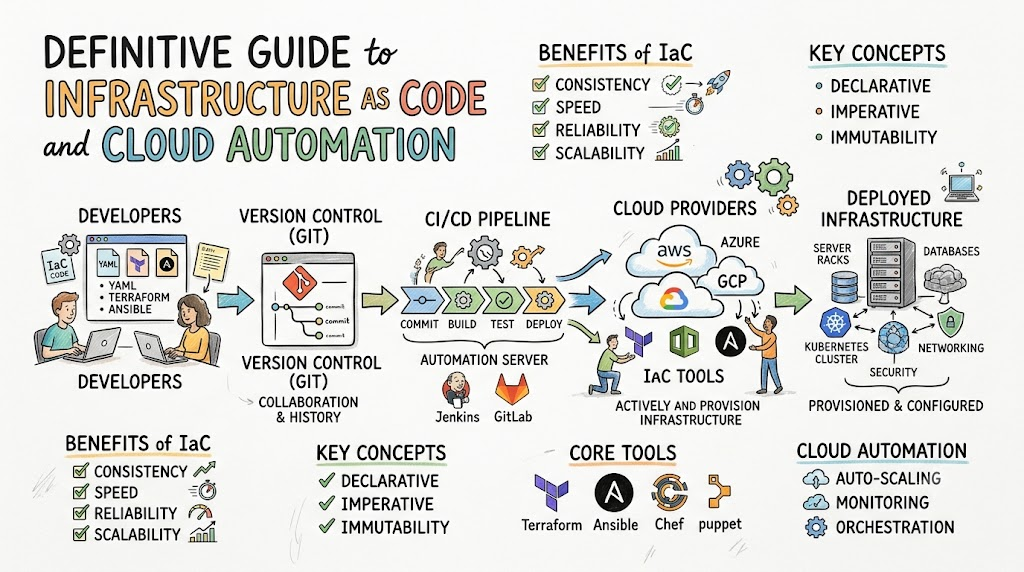
The implementation of Infrastructure as Code relies on a systematic lifecycle workflow that bridges the gap between text-based code definitions and live cloud resources. This process moves through several distinct phases to guarantee safety, predictability, and repeatability.
+------------------+     +-----------------+     +-----------------------+     +---------------------+
| 1. Write Code    | --> | 2. Version Ctrl | --> | 3. Execution Plan     | --> | 4. Apply & Provision|
| (TF, YAML, JSON) |     | (Git Repository)|     | (Dry Run Verification)|     | (Cloud API Actions) |
+------------------+     +-----------------+     +-----------------------+     +---------------------+
1. Defining the Infrastructure in Text Files
The lifecycle begins with the cloud engineer writing the desired state of the infrastructure using a domain-specific language (DSL) or standard data-serialization languages such as JSON or YAML. In this file, the engineer explicitly describes the required resources. For instance, the script might declare: “Create a virtual private cloud with a specific IP range, attach an internet gateway, and provision three virtual machines running a specified Linux distribution.”
2. Committing to Version Control Systems
Once the definition files are written, they are committed to a centralized version control repository, such as Git. This action establishes a definitive history of the infrastructure. Every single modification, addition, or deletion is tracked along with a cryptographic commit hash, a timestamp, and the identity of the engineer who authored the change. This step allows teams to implement peer code reviews through pull requests before any changes are allowed to modify live cloud environments.
3. Generation of the Execution Plan
Before executing the code against live cloud environments, modern IaC tools generate a dry-run report or an execution plan. This phase calculates the delta between the current state of the live cloud resources and the desired state declared within the newly written code files. The tool displays an explicit preview showing exactly which resources will be created from scratch, which resources will be modified in place, and which resources will be permanently destroyed.
4. Automated Execution and Provisioning
After an engineer or an automated CI/CD pipeline approves the generated execution plan, the IaC tool compiles the instructions and interacts directly with the target cloud provider’s Application Programming Interfaces (APIs). The tool handles all authentication, tracks complex resource dependencies, and executes the tasks in the optimal sequence. For example, it ensures that a network subnet is fully created before attempting to launch a virtual machine inside it.
Core Principles of Infrastructure as Code
To maximize the value of DevOps IaC basics, systems must be built upon foundational software engineering principles. These core rules ensure that infrastructure management remains stable and predictable as organizational scale grows.
| Principle | Meaning |
| Declarative Approach | Defining the desired final state of the system, leaving the tool to determine execution steps. |
| Version Control Integration | Keeping all infrastructure code inside repositories to maintain a clear audit trail. |
| Automation over Manual Action | Eliminating human interaction during the actual provisioning and deployment phases. |
| Idempotency | Ensuring that executing the code multiple times always yields the exact same environment state. |
| Reusability | Creating modular infrastructure blocks that can be easily repurposed across projects. |
Declarative vs. Imperative Approach
An imperative approach requires the engineer to write explicit, step-by-step instructions detailing how the system must arrive at a state. For example: “Run command A, then download package B, then alter config file C, then restart service D.” If any single step fails midway through, the system is left in a broken, half-configured state.
Conversely, the declarative approach—favored by modern tools like Terraform and CloudFormation—focuses entirely on what the final state should look like. The engineer simply declares: “I require a database instance with 50GB of storage and a specific user profile.” The IaC engine automatically reviews the existing cloud environment, determines what configuration gaps exist, and executes the precise operations needed to safely achieve that exact configuration.
Understanding Idempotency
Idempotency is a crucial mathematical and operational attribute of robust IaC systems. It guarantees that no matter how many times you run your infrastructure code, the outcome remains identical, and no unintended side effects are introduced.
If your code states that your environment should contain exactly four web servers, and you execute that code when zero servers exist, the tool will provision four servers. If you run that identical code a second time immediately afterward, the tool detects that four servers are already active and running happily. It will make absolutely no changes, rather than accidentally spinning up an additional four servers and doubling your cloud utility bill.
Popular Infrastructure as Code Tools
The modern DevOps landscape contains various tools designed to solve specific challenges within the cloud automation IaC ecosystem. These tools generally fall into two categories: infrastructure provisioning tools and configuration management tools.
Terraform by HashiCorp
Terraform is an open-source, cloud-agnostic infrastructure provisioning tool that uses the HashiCorp Configuration Language (HCL). It is widely considered an industry standard due to its ability to manage multi-cloud deployments simultaneously. Using an extensive provider ecosystem, a single Terraform script can provision a virtual machine in AWS, configure a DNS record in Cloudflare, and set up a monitoring dashboard in Datadog simultaneously.
AWS CloudFormation
AWS CloudFormation is a native, proprietary service built specifically for provisioning resources within the Amazon Web Services ecosystem. It utilizes JSON or YAML templates to define complex cloud architectures. While it lacks multi-cloud support, CloudFormation provides deep integration with AWS features, immediate support for newly released services, and managed state files handled natively behind the scenes by Amazon.
Ansible
Ansible is an open-source configuration management and orchestration tool that utilizes simple human-readable YAML playbooks. Unlike provisioning tools designed to build the foundational virtual network and server shells, Ansible specializes in configuring software inside those servers once they are online. It is agentless, meaning it connects to target servers securely over standard SSH or WinRM protocols to install packages, manage user permissions, and enforce security baselines without requiring background software daemons.
Pulumi
Pulumi represents a modern evolutionary shift in the IaC market by allowing engineers to replace traditional data-serialization languages like YAML or custom DSLs with standard, real-world programming languages. With Pulumi, developers can write infrastructure configurations using TypeScript, Python, Go, or C#. This capability enables teams to write native unit tests, implement complex object-oriented design patterns, and leverage existing software IDE autocomplete features directly within their infrastructure workflows.
| Tool | Core Category | Ideal Use Case |
| Terraform | Infrastructure Provisioning | Multi-cloud deployments and heterogeneous infrastructure stacks. |
| AWS CloudFormation | Infrastructure Provisioning | Organizations operating exclusively inside the Amazon Web Services ecosystem. |
| Ansible | Configuration Management | Post-provisioning server setup, software installation, and application deployment. |
| Pulumi | Infrastructure Provisioning | Engineering teams preferring native programming languages over custom DSLs. |
| Chef / Puppet | Configuration Management | Enforcing strict, continuous compliance states across long-lived enterprise server fleets. |
Real-World Example: Without IaC
To truly understand how much value this methodology brings, let us look at a realistic engineering scenario: building a standard, secure three-tier web application architecture inside a cloud environment without using any code.
Imagine a technology company onboarding a new software engineer and assigning them the manual task of building out a staging environment that mirrors production. The engineer must follow these manual steps:
- Log into the web console interface using corporate administrative credentials.
- Navigate to the networking tab and create a Virtual Private Cloud (VPC).
- Manually compute subnets, type in CIDR blocks, and build routing tables.
- Create security groups and meticulously enter individual firewall port rules for web, application, and database tiers.
- Launch five virtual machines, manually choosing instance sizing, disk encryption keys, and operating system images.
- Connect to each virtual machine individually via a terminal to update system packages, install runtime engines, and manually paste application configuration files.
- Create a managed database instance, select sizing parameters, and manually link connection strings.
The Chaos of Manual Setup
This manual journey is fraught with systemic operational friction. The engineer might spend an entire working week clicking through screens to complete the configuration. Halfway through the setup, they might easily mistype an IP address range or accidentally leave a database port accessible from the public internet.
Worse yet, there is no centralized log or code file to verify that the staging environment matches production perfectly. When the development team attempts to deploy their software onto this manually built staging environment, it throws errors because the version of the database engine selected from the dropdown menu was slightly newer than the version running in production. The team loses days of engineering time troubleshooting environment discrepancies instead of delivering product value.
Real-World Example: With IaC
Now let us look at how that identical three-tier architecture is deployed using a modern Infrastructure as Code workflow. Instead of clicking through a graphical console interface for days, a cloud automation specialist writes a modular configuration file.
The engineer creates a single main.tf or cloudformation.yaml script. Within this text file, the architecture is clearly defined as standard, readable configuration blocks:
Plaintext
resource "cloud_virtual_network" "production_vpc" {
  cidr_block = "10.0.0.0/16"
}

resource "cloud_compute_instance" "web_servers" {
  count         = 5
  instance_type = "t3.medium"
  os_image      = "ubuntu-24.04"
  security_group_ids = [cloud_security_group.web_traffic.id]
}
The Power of Automation
When this file is checked into a Git repository, it immediately undergoes automated validation. A peer developer reviews the pull request, verifies that the security rules are compliant with corporate policies, and approves the change.
The CI/CD automation pipeline takes over, executing the deployment tool. In less than three minutes, the automation engine communicates directly with the cloud APIs, constructing the network, building the firewalls, spinning up the five virtual machines, linking the databases, and configuring the applications.
If the company needs to deploy an identical environment in a completely different geographical region to comply with new data regulations, the engineer does not repeat a massive list of manual steps. They simply pass a different region variable to the exact same script and run it again. The exact same infrastructure architecture is stamped out flawlessly on the other side of the planet in minutes.
Benefits of Infrastructure as Code
Implementing IaC DevOps foundations delivers deep operational and strategic advantages across the entire software engineering lifecycle. It goes beyond simple speed enhancements to fundamentally alter how teams collaborate and manage risk.
                  +-----------------------------------+
                  |   BENEFITS OF IMPLEMENTING IaC   |
                  +-----------------------------------+
                                    |
         +-----------------+--------+--------+-----------------+
         |                 |                 |                 |
+-----------------+ +-------------+ +-----------------+ +-------------+
| Rapid Velocity  | | Guaranteed  | | Massive Elastic | | Bulletproof |
|  & Execution    | | Consistency | |  Scalability    | | Audit Trail |
+-----------------+ +-------------+ +-----------------+ +-------------+
Rapid Velocity and Execution
By replacing human manual interactions with automated API executions, deployment speed increases exponentially. Environments that previously required days of collaborative cross-team effort are built in minutes. This agility allows development teams to spin up temporary environments for testing individual features and tear them down immediately when done, accelerating time-to-market.
Guaranteed Environment Consistency
Because infrastructure states are derived directly from a single immutable source of truth—the code—the issue of configuration drift is virtually eliminated. Development, testing, staging, and production environments become carbon copies of one another. This guarantees that software behaves predictably as it progresses through your internal deployment pipelines, dramatically lowering post-release production errors.
Massive Elastic Scalability
Cloud architectures must expand and contract dynamically based on user demand. IaC allows organizations to scale their physical footprint seamlessly. Whether you need to duplicate a microservices cluster across multiple regions or scale out compute instances to handle a seasonal traffic spike, running code-based configurations makes horizontal scaling effortless.
Bulletproof Audit Trails and Governance
When infrastructure is written as code, every single configuration change is captured inside your Git history. If an unauthorized port is opened or a cluster size is modified, security teams can run Git blame commands to identify exactly who authored the change, when it was introduced, and why it was committed. Compliance documentation transforms from a manual guessing game into an automated software report.
Challenges of Infrastructure as Code
While cloud automation IaC provides incredible capabilities, it introduces unique engineering difficulties and operational risks that teams must manage to avoid severe system problems.
Steep Learning Curve and Shift in Mindset
Transitioning to IaC requires traditional system administrators to evolve into software developers. They must learn development methodologies, including Git workflows, branching strategies, software testing paradigms, and custom domain-specific languages. This paradigm shift can cause friction in organizations accustomed to traditional manual system administration.
Complex State Management Issues
Tools like Terraform keep a detailed record of your live cloud resources inside a metadata file known as a state file. This state file serves as the single source of truth mapping your code definitions to real-world cloud assets. If this state file becomes corrupted, out of sync due to manual parallel edits, or accidentally deleted, the IaC tool loses track of your environment. Resolving state conflicts requires specialized expertise and careful manual correction.
Amplification of Security Vulnerabilities
Because IaC scales infrastructure effortlessly, it can scale security flaws just as easily. If a developer accidentally commits an insecure configuration change—such as leaving a storage bucket publicly writeable—to a core infrastructure template, that critical security flaw will be automatically deployed across every single environment inside the organization. Furthermore, engineers must implement secure secrets management tools to ensure that sensitive API keys and database passwords are never committed to raw git text repositories.
Common IaC Mistakes Engineers Make
When teams begin implementing DevOps IaC basics without proper training or clear guidelines, they frequently fall into predictable traps that undermine the stability and security of their environments.
- Hardcoding Sensitive Values and Credentials: Storing plain-text passwords, database connection strings, and secret keys directly inside code repositories where they can be leaked or stolen.
- Neglecting Version Control and State Files: Modifying production assets manually while forgetting to update the corresponding repository files, triggering massive state file mismatches.
- Creating Monolithic, Massive Blueprints: Writing a single code file that attempts to manage the entire enterprise infrastructure footprint, creating a single point of failure and slow deployment pipelines.
- Skipping Automated Linting and Security Scans: Deploying code configurations to live cloud providers without first running pre-execution validation checks or automated security vulnerability scans.
- Failing to Track Configuration Drift: Ignoring unauthorized manual modifications made to systems by ad-hoc support teams during operational incidents.
Best Practices for Learning and Using IaC
To build resilient, maintainable, and secure automated infrastructure systems, engineering teams must follow standard industry best practices.
1. Adopt a Strictly Declarative Approach
Whenever possible, select tools and design patterns that enforce declarative philosophies. Avoid using inline shell scripts or execution wrappers inside your configuration files to force imperative behaviors. Allow your IaC engine to manage resource lifecycles natively.
2. Implement the Principle of Least Privilege
Ensure that the automated service accounts and CI/CD runners executing your IaC templates are granted only the absolute minimum permissions required to perform their specific tasks. Never run infrastructure deployment pipelines using full root or global cloud administrative permissions.
3. Decouple Code into Small, Reusable Modules
Break apart massive monolithic code architectures into specialized, isolated modules. Create a dedicated module for core networking, a separate module for database storage, and individual modules for application compute layers. This isolation reduces blast radiuses and allows teams to safely update individual services independently.
4. Enforce Strict Pull Request Workflows
Never allow code changes to be merged directly into main repository branches without peer approval. Every infrastructure change should undergo a detailed pull request review process where senior architects can review the generated execution plans and verify architectural compliance before deployment.
5. Automate with Pre-Commit Linters and Scanners
Integrate automated testing tools directly into your engineering workflows. Utilize code linters and security analysis utilities like TFLint, Checkov, or Tfsec to catch misconfigurations, open security groups, and syntax errors before the code is ever committed to a central repository.
Role of DevOpsSchool in Learning Infrastructure as Code
Successfully transitioning to a code-driven infrastructure model requires more than reading documentation; it demands immersive, hands-on experience dealing with real-world failure modes and complex multi-cloud deployments. Organizations and individuals looking to bridge this skills gap can leverage the structured, expert-led training ecosystems provided by DevOpsSchool.
DevOpsSchool offers specialized educational programs tailored to help engineers move from foundational DevOps IaC basics up to advanced cloud automation engineering. Their syllabus focuses heavily on practical application, moving past abstract syntax rules to immerse students directly into real-world production scenarios.
Through guided lab environments, students learn how to architect scalable Terraform configurations, manage state files securely across distributed teams, write reusable modules, and design automated CI/CD pipelines that execute infrastructure changes safely. This mentor-driven approach ensures that engineers do not just learn how to write code, but thoroughly understand the core structural paradigms needed to manage enterprise systems reliably and securely at global scale.
Career Importance of IaC Skills
The tech industry has shifted permanently away from manual system administration. Organizations globally are migrating aggressively to cloud-native, automated operating models. As a result, mastery of Infrastructure as Code has become an absolute prerequisite for high-paying engineering roles.
DevOps Engineer
Within a DevOps culture, the wall between software developers and operations teams is broken down. A DevOps engineer uses IaC to build unified, automated software pipelines where application code and infrastructure code move through validation pipelines together, eliminating historical deployment bottlenecks.
Cloud Architect
Cloud architects are responsible for designing the structural blueprints of an organization’s cloud footprint. They use IaC to define reference architectures, ensuring that security guardrails, governance frameworks, and cost-optimization baselines are built directly into the foundational templates used across the entire company.
Site Reliability Engineer (SRE)
SREs focus on maximizing system availability, performance, and reliability. They leverage IaC to ensure environments are completely predictable, reproducible, and resilient. By writing infrastructure as software, SREs can easily automate disaster recovery scenarios, spinning up entirely new mirrored environments in alternate cloud regions instantly if a primary data center fails.
Industries Using Infrastructure as Code
The adoption of Infrastructure as Code spans across every vertical sector that relies on modern cloud computing infrastructure to deliver business value.
+-------------------------------------------------------------------+
|                  INDUSTRIES POWERED BY IaC                        |
+-------------------------------------------------------------------+
|                                                                   |
|  [Banking & Finance]  --> Enforces strict compliance & security   |
|  [Healthcare Systems] --> Guarantees data privacy & isolation     |
|  [E-Commerce Tech]    --> Scales dynamically for traffic spikes   |
|  [SaaS Organizations] --> Automatically provisions tenant stacks  |
|                                                                   |
+-------------------------------------------------------------------+
Banking and Financial Institutions
The financial services industry operates under highly strict regulatory compliance frameworks. Financial institutions leverage IaC to build immutable audit histories. Because every firewall alteration and encryption setting is defined in code and preserved in Git, these companies can instantly demonstrate compliance to government auditors without pausing daily business operations.
Healthcare Systems
Healthcare providers handle highly sensitive personal health information that requires absolute data isolation and strict access controls. IaC allows healthcare cloud engineers to build isolated, encrypted data enclaves predictably. This ensures that human setup mistakes never accidentally expose private medical data to the public internet.
High-Volume E-Commerce Platforms
E-Commerce applications experience massive, predictable traffic spikes during seasonal promotional events or holiday shopping periods. These platforms utilize IaC blueprints to automatically scale out their front-end container fleets, caching infrastructure, and database read-replicas ahead of peak traffic times, shrinking the environment back down afterward to minimize infrastructure costs.
Future of Infrastructure as Code
The discipline of cloud automation IaC is continually evolving, moving beyond simple static configuration files toward deeply integrated, intelligent automation systems.
The Rise of GitOps
GitOps is an operational framework that takes IaC principles to their logical conclusion. In a GitOps model, the desired state of a live infrastructure environment is continuously synchronized with a Git repository using software agents. If a human attempts to manually log into a live server and change a setting, the GitOps controller detects this variance from the code repository, flags the unauthorized change, and automatically overwrites the environment back to the approved state declared in Git.
Integration of Policy as Code (PaC)
As security management scales, manual code reviews can become a development bottleneck. The industry is rapidly adopting Policy as Code frameworks, such as Open Policy Agent (OPA). This technology allows security teams to write explicit compliance guardrails in code. For instance, a policy might state: “No virtual machine may be created with a public IP address.” The automated pipeline scans incoming IaC templates against these compliance rules, instantly blocking any deployment that violates corporate security policies.
AI-Driven Infrastructure Optimization
The integration of machine learning and large language models is starting to reshape how infrastructure code is generated and optimized. Future IaC systems will not only assist engineers in writing syntax-correct templates but will continuously analyze running cloud systems to dynamically suggest refactoring strategies, discover hidden security vulnerabilities, and rewrite code files automatically to minimize resource expenditures.
FAQs (Frequently Asked Questions)
What is Infrastructure as Code?
Infrastructure as Code is an operational practice where server infrastructure, networking components, storage systems, and security layers are provisioned, managed, and versioned using machine-readable definition files rather than manual point-and-click operations or interactive scripts.
Why is IaC important in DevOps?
IaC is a foundational pillar of DevOps because it bridges the operational gap between application development and system deployment. It eliminates manual environment setup errors, ensures absolute consistency between staging and production environments, and enables automated CI/CD pipelines to build and scale infrastructure rapidly.
Is IaC difficult for beginners to learn?
While it requires a fundamental shift in mindset from manual system administration to software engineering, IaC is highly accessible for beginners. Starting with simple, human-readable declarative languages like Terraform’s HCL allows beginners to understand basic provisioning workflows before moving on to complex enterprise architectures.
What are the most popular IaC tools?
The industry standard tools include Terraform for multi-cloud infrastructure provisioning, AWS CloudFormation for native Amazon Web Services deployments, Ansible for configuration management and application setup, and Pulumi for creating infrastructure stacks using real programming languages like Python and TypeScript.
Is Terraform enough for all IaC requirements?
Terraform is highly capable at provisioning base physical or virtual structures like networks, storage, and server containers. However, organizations frequently pair Terraform with configuration management tools like Ansible to handle software installations and configuration setups inside those servers once online.
What is configuration drift and how does IaC solve it?
Configuration drift occurs when live environments gradually mutate over time due to untracked manual modifications or hotfixes. IaC mitigates this risk by serving as an absolute source of truth. Running an IaC execution plan allows the automation tool to scan the environment, detect drift, and restore the infrastructure back to its approved code specification.
What is the difference between declarative and imperative IaC?
An imperative approach requires the engineer to define the exact sequence of commands the system must execute to arrive at a destination. A declarative approach simply requires the engineer to define the final desired state of the system, leaving the underlying IaC engine to automatically figure out the steps needed to safely achieve that state.
Can IaC be used for on-premises infrastructure?
Yes. While IaC is widely celebrated for its cloud capabilities, tools like Terraform and Ansible feature extensive provider extensions designed to automate on-premises virtualization platforms like VMware vSphere, OpenStack, and physical bare-metal hardware network switches.
How does IaC improve cloud security?
IaC enhances security by removing human configuration mistakes from the deployment equation. It allows security teams to build hardened infrastructure templates, embed automated vulnerability scanners directly into deployment pipelines, and maintain an immutable historical record of every configuration change via Git tracking.
What is an IaC state file?
An IaC state file is a detailed metadata record utilized by tools like Terraform to map your written configuration code to real-world resources running inside your cloud provider. It tracks resource dependencies, attributes, and identifiers, allowing the tool to calculate necessary updates safely.
Why should secrets not be stored in IaC templates?
Storing plain-text secrets like passwords, private keys, or API tokens inside IaC files exposes them to anyone with read access to the code repository. Best practices mandate utilizing dedicated external secret managers to inject credentials dynamically into environments at execution time.
What is GitOps?
GitOps is an advanced evolutionary design pattern where Git repositories serve as the absolute source of truth for operational infrastructure. Software delivery loops continuously monitor the repository and automatically synchronize the live cloud state with the approved configuration code, auto-correcting any unauthorized manual changes.
Can beginners learn IaC without learning a coding language first?
Yes. Many leading tools like Terraform and CloudFormation utilize simple, human-readable data-serialization languages or domain-specific configurations designed to be straightforward and clear, making them highly approachable for individuals without formal software programming backgrounds.
What is Policy as Code?
Policy as Code is the practice of managing and enforcing compliance, security, and operational guardrails through code. It allows automated pipelines to programmatically evaluate IaC scripts against corporate rules, blocking non-compliant deployments before they are ever built.
How does DevOpsSchool help in mastering IaC?
DevOpsSchool provides comprehensive, structured learning pathways led by veteran industry practitioners. Their courses blend theory with hands-on lab environments, allowing students to master foundational tools, learn advanced multi-cloud workflows, and build real-world automation skills needed to excel in modern enterprise cloud careers.
Final Thoughts
The emergence of Infrastructure as Code has fundamentally transformed the discipline of system administration, reshaping it into a highly rigorous, sophisticated branch of software engineering. The historical paradigms of manual server provisioning, undocumented configuration updates, and baseline environment drift are no longer viable in an era defined by rapid cloud delivery models and microservice architectures.
By treating infrastructure as software, organizations gain unprecedented control, speed, and visibility over their environments. Automation ensures that systems are deployed consistently, audit paths are preserved clearly within version histories, and human error is minimized.
For technology professionals navigating this modern landscape, developing deep expertise in cloud automation IaC is no longer just a valuable career addition; it is an absolute foundational skill required to build and maintain the scalable, secure cloud-native systems of tomorrow.
